Family Friendly & Specialty Dentists in London, UK
If you've experienced tooth loss, the three most common options are resin-bonded bridges, conventional bridges, and dental implants. In this article, we will explore each option in detail and help you determine which one is the best fit for your dental needs.
Resin-retained bridges, also known as Maryland bridges, are a great option for replacing missing front teeth. They consist of a false tooth, or pontic, that is fused to metal or porcelain wings. These wings are then bonded to the back of the adjacent teeth, providing support for the pontic.
Resin-bonded bridges are a minimally invasive option, as they require little to no alteration of the surrounding teeth. They are also more affordable than other options and can be completed in just a few visits. However, resin-bonded bridges have some limitations. They are not suitable for replacing molars or teeth that bear significant chewing force. They also have a shorter lifespan than other options, typically lasting between five to ten years. Making them appear totally natural can be really difficult in the front of the mouth. This is because of the gum recession that always occurs when a tooth is removed.
Conventional bridges are a popular option for replacing missing teeth. They consist of a pontic that is anchored to adjacent teeth with dental crowns. These crowns are cemented in place, providing support for the pontic.
Conventional bridges are an excellent option for replacing molars or teeth that bear significant chewing force. They also have a longer lifespan than resin-bonded bridges, typically lasting between ten to fifteen years.
However, conventional bridges require significant drilling to the surrounding teeth and this option is therefore more invasive than the Maryland bridges above. They also tend to be more expensive than resin-bonded bridges and can take longer to complete but making them look natural is much easier than the resin-bonded bridges.
Dental implants are a popular option for replacing missing teeth, especially if you are missing a single tooth or multiple teeth. They consist of a titanium implant that is surgically placed into the jawbone, where it fuses with the bone over time. An abutment is then attached to the implant, which serves as a connector for the replacement tooth. The fact that they are strong and do not require any drilling to the surrounding teeth makes them the least destructive and strong of all 3 options.
Dental implants are the most durable and long-lasting option, with a lifespan of 10-20 years (assuming you see your hygienist every 3 months). They also provide the most natural look and feel, as they closely mimic the structure and function of natural teeth.
Because of the aforementioned advantages (strength, excellent appearance and natural feel) dental implants are the most extensive of the 3 options (see our article on dental implant costs). They also tend to be the most expensive option, particularly if multiple implants are needed.
The best option for you will depend on various factors, such as the location of the missing teeth, your budget, and your overall dental health.
If you are missing incisors and want a less invasive and more affordable option, resin-bonded bridges may be the best choice but you might compromise on appearance. If you are missing molars or teeth that bear significant chewing force, conventional bridges may be the better option. If you want the most durable and natural-looking option, dental implants may be the ideal choice. Ultimately, the best way to determine which option is right for you is to consult with a specialist dentist. They will be able to assess your dental needs and provide personalised recommendations.
We understand that choosing the right option for replacing missing teeth can be a difficult decision, and we are here to help. Our team will take the time to answer any questions you may have, and provide detailed information about each option so that you can make an informed decision. Please complete this short form and one of us will be in contact by the next working day.
In this article, I will compare porcelain crowns and porcelain veneers, and help you decide which one is right for you.
Porcelain crowns, also known as dental caps, are dental prosthetics that are designed to cover the entire tooth. They are usually recommended for patients with teeth that have been damaged by decay, injury, or other factors. Porcelain crowns can also be used to improve the appearance of teeth that are discoloured, misshapen, or have large fillings.
Porcelain crowns are custom-made to fit your tooth and mimic the look of your natural teeth. They are durable and can last for many years with proper care. Porcelain crowns are also stain-resistant and easy to maintain, making them a great option for people who want a long-term solution for their dental problems. However, there is about a 10-20% chance that you will need a root canal treatment afterwards.
Porcelain veneers are thin, custom-made shells that are designed to cover the front surface of your teeth. They are a popular cosmetic dental procedure that can be used to improve the appearance of teeth that are discoloured, misshapen, or have small gaps. Porcelain veneers are often recommended for patients who want a quick and easy solution to their dental problems.
Porcelain veneers are designed to look like natural teeth and are bonded to the front of your teeth. They are durable and can last for many years with proper care. Porcelain veneers are also stain-resistant and easy to maintain, making them a great option for people who want to improve their smile without undergoing extensive and destructive dental work. (See our article on every everything you need to know about porcelain veneers)
While both porcelain crowns and porcelain veneers are great for improving the appearance of your teeth, they have different applications and benefits. Here are some of the key differences between the two:
Porcelain crowns cover the entire tooth, while porcelain veneers only cover the front surface of your teeth. If you have a tooth that is severely damaged or decayed, a porcelain crown may be the best option for you. If it is not, the porcelain veneer is much better.
Porcelain crowns are more durable than porcelain veneers, and can last for many years with proper care. Porcelain veneers, on the other hand, are thinner and more delicate, and may need to be replaced after 10 to 15 years. However, if the tooth has no fillings and the teeth are straightened beforehand i.e. lots of enamel present, the difference between crowns and veneers is minimised.
Porcelain crowns may be more expensive than porcelain veneers, due to the amount of material and work required to make them (see our article on cost of porcelain veneers). Porcelain veneers are a more cost-effective option for patients who want to improve the appearance of their teeth without breaking the bank.
Porcelain crowns require more preparation than porcelain veneers, as the entire tooth needs to be filed down to accommodate the crown. Porcelain veneers, on the other hand, require less preparation and can be bonded to the front of your teeth with minimal removal of the tooth structure.
Whether you should opt for porcelain crowns or porcelain veneers depends on your individual needs and preferences. If you have a severely damaged tooth, a porcelain crown may be the best option for you. If you want to improve the appearance of your teeth without undergoing extensive dental work, porcelain veneers may be a better option. One important thing to note is that both porcelain crowns and porcelain veneers require healthy teeth and gums to ensure their success. If you have underlying dental problems, such as gum disease or decay, those issues should be addressed before undergoing cosmetic procedures.
As a dentist, I always recommend that patients schedule a consultation with me before making a decision about which cosmetic dental procedure to undergo. During the consultation, we can discuss your individual needs and preferences, and I can help you determine which option is best for you.
If you have any questions for my team and I, please complete this form and one of us will be in contact on the next working day.
Gum disease affects many people, and if left untreated, it can lead to more serious issues such as tooth loss. (See our other gum disease article). Two popular treatments for gum disease are regenerative and osseous resective gum surgery. In this article, we'll compare these two types of surgery and help you determine which one may be right for you. They are required with non-surgical gum therapy does not result in shallow (4mm or less) gum pockets.
Guided tissue regeneration, aims to regenerate lost bone and tissue in the gums. This surgery involves placing a special membrane or barrier over the affected area of the gums. The membrane helps guide the growth of new bone and tissue, allowing the gums to heal and regenerate. This membrane and associated bone mineral can be either generated from cows/pigs or other human beings. It is therefore extremely important that you inform your dentist if you have any religious or cultural objections/concerns.
Regenerative gum surgery is ideal for cases where the defective bone/gum is narrow and localised. Its main advantage is that it is associated with much less gum recession than the resective surgery below.
Osseous resective gum surgery and open flap debridement are types of periodontal surgery that involve the removal of damaged gum tissue. These procedures are ideal for much more severe cases of gum disease, where the damage extends to multiple teeth. In these cases, root canal treatments can also be required (see our article on root canal treatments).
During osseous resective gum surgery, the damaged tissue is removed, allowing the healthy tissue to heal and grow back. This reduces the size of pockets that have formed between the teeth and gums, making it easier to keep the area clean and free of bacteria.
The severity of your gum disease and overall oral health are the determining factors for which type of gum surgery is right for you. Your dentist will assess your condition and recommend the most appropriate treatment.
Regenerative gum surgery is best for severe cases of gum disease. However, it may not be appropriate for everyone, especially those with underlying health issues. Resective gum surgery is a less invasive option that is often used to treat mild to moderate cases of gum disease, reducing the size of pockets and promoting gum health.
Regenerative and osseous resective gum surgery are viable treatment options for gum disease. To ensure your gums' health, see a us as soon as possible to discuss your treatment options. Please complete the form below.
Gum recession can cause significant oral health issues, including tooth sensitivity and compromised appearance. Gingival grafting is a common procedure that can treat receding gums, and there are two sources for gum tissue grafts: the patient's own palate and tissue from other donors. In this article, we'll compare autografts and allografts to help you make an informed decision about which is right for you.
An autograft is gum tissue taken from the patient's own palate. This tissue is a perfect match for the patient's existing gum tissue, and it eliminates the risk of disease transmission and rejection that can occur with allografts (this is very rare). However, harvesting tissue from the palate can be a painful and uncomfortable process, and the limited amount of tissue that can be harvested can make this option impractical for larger areas of recession. When successful, the appearance appears very natural.
An allograft is gum tissue taken from a donor other than the patient. This option is less painful and invasive than an autograft, and the recovery time is often faster since there is no need for a second surgical site. However, there is a very small risk of disease transmission, although this risk is very low when proper screening and processing protocols are followed. Additionally, the tissue may not be a perfect match for the patient's existing gum tissue, which can lead to a less natural appearance.
The decision to use an autograft or allograft will depend on several factors, including the size and location of the affected area, the patient's medical history, and their personal preferences. As a dental professional, it's important to discuss the pros and cons of each option with your patients so that they can make an informed decision (please see our other article on gum recession).
When you choose to work with us for your gum grafting procedure, we'll take the time to understand your unique situation and recommend the best course of action. We have years of experience with both autografts and allografts, and we'll work with you to ensure a successful outcome.
Complete the form below and we will contact you within 24 hours.
In this article, we will compare conventional dentures and implant-supported bridges to help you make an informed decision about the best solution for your oral health.
Conventional dentures are removable prosthetic devices that replace all the missing teeth. They rest on the gums and are held in place by suction or denture adhesive. Dentures have been a popular option for many years due to their affordability and ease of use. However, they can be uncomfortable, bulky and unstable.
Conventional dentures can cause gum irritation, mouth sores, and bone loss, which may result in the need for regular adjustments or even replacement. Patients may also experience difficulty chewing, speaking, and a reduced sense of taste due to the covering of the palate.
Implant-supported bridges, on the other hand, are fixed restorations that replace missing teeth by attaching to dental implants surgically placed in the jawbone. These bridges are more stable and comfortable than conventional dentures, and they do not cover the palate. Implant-supported bridges provide a more natural look and feel, giving patients a renewed sense of confidence and improved oral function.
Unlike conventional dentures, implant-supported bridges do not require regular adjustments or replacements. They also help to prevent bone loss, which occurs when teeth are missing. Dental implants have been used for over 40 years and have a success rate of over 95%.
When it comes to cost, conventional dentures are more affordable than implant-supported bridges. However, while the initial cost of implant-supported bridges may be higher, they may save you money in the long term as they don't need to be replaced as often.
In terms of comfort, implant-supported bridges win hands down. They are more comfortable and stable than conventional dentures, which can move or shift during eating and speaking. Implant-supported bridges are a fixed solution, meaning you won't have to worry about taking them out and cleaning them like you would with dentures.
When it comes to oral health, implant-supported bridges are the better choice. They help to prevent bone loss, which can lead to facial collapse and the need for bone grafts. Conventional dentures can cause bone loss over time and may require regular adjustments to fit correctly.
As a specialist dentist, I've seen first-hand the positive impact that conventional dentures and implant bridges have had on my patients. Please see what Alexandra had to say about conventional dentures and Sandra had to say about implant-supported bridges.
If you have any questions about this topic, please complete this form and one of the team will be in touch by the next working day.
Dental bridges are a popular solution for missing teeth. Conventional bridges and resin-bonded bridges are two of the most common options, but how do you know which one is right for you? In this comprehensive guide, we will explore the differences, advantages, and disadvantages of both types of bridges, as well as guide you through the decision-making process to help you choose the best option for your oral health.
Conventional bridges, also known as traditional bridges, consist of a false tooth, called a pontic, that is held in place by two dental crowns. The crowns are cemented onto the teeth adjacent to the gap, and the pontic sits in the space left by the missing tooth.
Conventional bridges are made from various materials, including porcelain, metal, and a combination of both. They are durable and can last for many years, with proper care and maintenance.
Resin-retained bridges, also known as Maryland bridges, are a less invasive and more conservative option for replacing missing teeth. They consist of a false tooth, held in place by a metal or porcelain framework that is bonded to the back of the adjacent teeth.
Resin-bonded bridges are a popular choice for patients who have only one missing tooth or who have small gaps between their teeth. They work much better in the front of the mouth than the back. They are less invasive than conventional bridges, as they do not require the removal of tooth structure from adjacent teeth.
When comparing the two types of bridges, it is important to consider the following factors:
Resin-bonded bridges are generally less expensive than conventional bridges. This is because they require less preparation work and fewer materials.
Conventional bridges are more durable than resin-bonded bridges and can last for up to 10-15 years, while resin-bonded bridges last for an average of 5-10 years. However, the longevity of the bridge also depends on the patient's diet, oral hygiene habits, bite scheme and the amount of wear and tear on the bridge.
Conventional bridges are more invasive than resin-bonded bridges as they require the removal of tooth structure from adjacent teeth. This invasiveness is what makes them strong. In contrast, resin-bonded bridges are less invasive, making them a more appealing option for many patients.
Both types of bridges can look natural and blend in with the surrounding teeth. However, resin-bonded bridges have a metal or porcelain framework that is visible from the back of the teeth, which some patients may find unappealing.
Conventional bridges are suitable for patients with a significant amount of tooth decay, weakened teeth, or a large gap between their teeth. On the other hand, resin-bonded bridges are suitable for patients who have only one missing tooth or a small gap between their teeth.
Choosing between resin-bonded bridges and conventional bridges depends on various factors, including your budget, the location of the missing tooth, and the overall health of your teeth. To help you make an informed decision, consider the following steps:
By following these steps, you can make an informed decision and choose the best option for your individual needs.
Both resin-bonded bridges and conventional bridges can provide a solution for missing teeth. Conventional bridges are a stable and permanent solution that can provide extra support to weakened teeth, while resin-bonded bridges are a less invasive and more conservative option that is quicker and less expensive.
If you are considering getting a dental bridge, speak to your dentist today and explore your options for a brighter and healthier smile. If you have any questions, please complete this form and one of the team will be in touch on the next working day.
In this article, we will compare porcelain veneers and composite bonding to help you determine which is right for you. As a dentist with years of experience, I have seen countless patients who are unhappy with their smile. Whether it’s due to discoloration, chipped or crooked teeth, or other imperfections, many people feel self-conscious about their teeth. Fortunately, there are several options available to enhance your smile.
Porcelain veneers are thin shells of porcelain made to fit over the front surface of your teeth. They are designed to improve the appearance of teeth that are discoloured, chipped, or misshapen. Porcelain veneers are considered to be a long-lasting solution to cosmetic dental problems.
Composite bonding is a procedure in which a tooth-coloured resin material is applied to the surface of the teeth. The material is shaped and moulded to match the appearance of the surrounding teeth and is then hardened using a special light. This procedure is often used to improve the appearance of chipped, cracked or discoloured teeth.
When it comes to deciding between porcelain veneers and composite bonding, there are a few things to consider.
Porcelain veneers are considered to be the gold standard in cosmetic dental procedures, as they provide a very natural-looking and long-lasting solution. They are custom-made to fit your teeth and are designed to look and feel like natural teeth. Composite bonding can also provide excellent results, but the material used is not as strong as porcelain and may not last as long.
Porcelain veneers are known for their durability and can last anywhere from 10-15 years or even longer with proper care. However, composite bonding is not as durable and will need to be replaced every 5-7 years.
Porcelain veneers are generally more expensive than composite bonding, but the long-lasting nature of porcelain veneers may make them a more cost-effective option over time.
The procedure for both porcelain veneers and composite bonding is relatively similar. The main difference is that porcelain veneers require the removal of a small amount of tooth enamel to make room for the veneer. Composite bonding does not require the removal of enamel, but may require more frequent touch-ups and repairs.
If you are looking for a long-lasting, natural-looking solution, porcelain veneers may be the right choice. However, if you are looking for a less expensive option that can be easily repaired, composite bonding may be a better fit.
In conclusion, both porcelain veneers and composite bonding are excellent options for improving the appearance of your smile. When deciding which option is right for you, it’s important to consider factors such as appearance, durability, cost, and the procedure itself. By working with a qualified cosmetic dentist, you can determine which procedure will provide you with the best possible results.
If you have any questions for us, please complete this form and one of the team will be in touch by the next working day.
We will compare metal and ceramic braces in this article and to help you decide which one is right for you.
Metal braces are the traditional type of braces that have been used for many years. They are made of high-grade stainless steel and consist of brackets, wires, and elastic bands. Metal braces are highly effective in straightening teeth and correcting bite issues. They are suitable for patients of all ages.
One of the most significant advantages of metal braces is their strength and durability. They can withstand a lot of pressure and can effectively move teeth into the desired position. Metal braces are also more affordable (see our article on costs of teeth straightening) than ceramic braces, making them a popular choice for many patients.
The biggest drawback of metal braces is their appearance. Some patients feel self-conscious about the metal brackets and wires and may avoid smiling or laughing in public. Another disadvantage is that metal braces can cause discomfort and irritation to the cheeks and lips, especially in the early stages of treatment.
Ceramic braces are similar in design to metal braces, but they are made of clear or tooth-coloured materials that blend in with the teeth. This makes them less noticeable and a popular choice for patients who want a more discreet orthodontic treatment.
The main advantage of ceramic braces is their appearance (see our article on teeth straightening features and problems- They are less noticeable than metal braces, making them a popular choice for patients who want to maintain a natural-looking smile during treatment. Ceramic braces are also more comfortable than metal braces, as they are smoother and do not irritate the cheeks and lips as much.
The main disadvantage of ceramic braces is their fragility. They are not as strong as metal braces and can chip or break if improperly handled. Ceramic braces are also more expensive than metal braces, which can be a deciding factor for some patients.
The decision between metal and ceramic braces ultimately comes down to personal preference and your individual orthodontic needs. If you are looking for an affordable and effective orthodontic treatment, metal braces may be your best option. Ceramic braces may be the way to go if you are looking for a more discreet treatment and are willing to invest in the extra cost.
To further help you understand the differences between metal and ceramic braces, we have created a visual comparison chart:
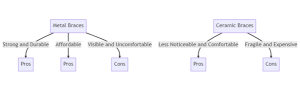
By providing you with this guide and comparison chart, we hope to have made your decision-making process more accessible and more informed. We encourage you to ask questions, seek advice, and take the time to make the best decision for you and your unique needs.
Please complete the form below for further information.
In this article, we'll compare lingual braces and clear aligners and help you decide which one is right for you.
Lingual braces are similar to traditional braces but are placed on the back of your teeth instead of the front. This makes them virtually invisible from the outside, which is an excellent option for people who want to straighten their teeth discreetly. Lingual braces are custom-made for each patient, which can make them more comfortable than traditional braces. We tend to use Incognito.
Clear aligners are removable, clear plastic trays that fit over your teeth. They apply pressure to your teeth in a controlled manner, gradually moving them into the desired position. Clear aligners are also virtually invisible, which makes them an excellent option for people who want to straighten their teeth without anyone knowing. We tend to use Spark and Invisalign.
Lingual braces have some advantages. They are virtually invisible, making them a great option for people concerned about their appearance. You also do not need to remember to wear them, which is fantastic (they are fixed and discreet). They are also custom-made for each patient, which means that they can be more comfortable than traditional lingual braces. However, lingual braces can be more challenging to clean than conventional braces, which can be a disadvantage (see our article on teeth straightening problems). They can also be more expensive (see our article on orthodontic treatment costs).
Clear aligners also have their advantages and disadvantages. They are virtually invisible, which makes them an excellent option for people who are concerned about their appearance. They are also removable, meaning you can take them out when you eat, brush your teeth, or floss. However, clear aligners can be more expensive than traditional braces, which is a disadvantage (see our article on costs of orthodontic treatment). They may also not be the best option for people with severe malocclusions (see article on teeth straightening problems)
The answer to this question depends on a number of factors, including the severity of your teeth alignment problem, your budget, and your personal preferences. If you want a treatment that is virtually invisible and custom-made for you, lingual braces may be the best option. On the other hand, if you want a treatment that is removable and more comfortable, clear aligners may be the best option. It's important to consult with your dentist to determine which option is best for you, but please be aware that if you are unable to commit to wearing clear aligners for 22 hours a day every day for 6-12 months, they will not work for you.
Please complete the short form below and one of our friendly team will contact you within 24 hours.
Many people prefer ceramic braces or clear aligners for teeth straightening because of their subtlety. But which one should you choose? Let’s compare ceramic braces and clear aligners to help you make an informed decision.
Ceramic braces are similar to traditional metal braces, but instead of metal brackets, they use clear or tooth-coloured brackets that blend in with your teeth. The wires that connect the brackets are also less noticeable, and some brands even offer wires that match the colour of your teeth. This makes ceramic braces a great option for people who want a more subtle look.
One advantage of ceramic braces is their durability (we tend to use 3M clarity brackets). They are made from strong materials and can withstand the wear and tear of daily life. They are also an effective way to correct a wide range of dental issues, including crowding, spacing, and bite problems.
However, ceramic braces do have some downsides. They can be more expensive than traditional metal braces, and they require more frequent adjustments. Additionally, the clear brackets can stain easily if you don’t take good care of them. You’ll need to brush and floss regularly and avoid foods and drinks that can stain your teeth, such as coffee, tea, and red wine.
Clear aligners are a newer option that have gained popularity in recent years. They are made from a clear plastic material that fits over your teeth and gradually shifts them into the desired position. You wear each set of aligners for a few weeks and then switch to the next set in the series. We tend to use Spark and Invisalign.
One advantage of clear aligners is their removability. You can take them out to eat and brush your teeth, which makes oral hygiene easier. They are also virtually invisible, so you can straighten your teeth without anyone knowing.
Clear aligners are a great option for people with mild to moderate dental issues. They can correct crooked teeth, spacing issues, and minor bite problems. However, they may not be as effective for more complex issues, such as severe crowding or bite problems.
Clear aligners also require a high level of compliance. You’ll need to wear them for at least 22 hours a day to get the best results. If you don’t wear them consistently, your treatment may take longer than expected.
Both ceramic braces and clear aligners have their advantages and disadvantages. The right option for you depends on your individual needs and preferences.
If you want a discreet look and have a wide range of dental issues, ceramic braces may be the best option for you. They are durable, effective, and blend in with your teeth.
If you prefer a more flexible and removable option and have mild to moderate dental issues, clear aligners may be the way to go. They are virtually invisible, and you can take them out for eating and oral hygiene.
Ultimately, the best way to determine which option is right for you is to schedule a consultation with your orthodontist. They can evaluate your dental issues and help you choose the best treatment plan.
Conclusion
Choosing between ceramic braces and clear aligners can be a difficult decision. Both options have their advantages and disadvantages, and the right choice depends on your individual needs and preferences. Consider the durability, cost, and maintenance of each option, and consult with your dentist to determine the best treatment plan for you.
As a dentist, I’ve seen first-hand the benefits of both ceramic braces and clear aligners. With the right treatment plan, you can achieve a beautiful, healthy smile that lasts a lifetime. If you have any questions for me, please complete this short form and one of the team will contact you within 24 hours.
