Family Friendly & Specialty Dentists in London, UK

Do you need a root canal or will a filling do? Dr Ope Sodeinde explains the signs, how dentists decide, and what each costs at London Dental Specialists.
If you have been told you need a root canal but were hoping for a simple filling, you are likely wondering why the more complex option is necessary. It often comes down to whether the damage is limited to the hard outer shell of the tooth or has reached the living tissue inside.
A small cavity on the chewing surface and an abscess brewing at the root of a tooth are both "tooth trouble," but they're treated in completely different ways. A filling patches a hole from the outside, usually with tooth-coloured composite resin, once decay has been cleaned out. A root canal goes much deeper, dealing with the soft tissue inside the tooth – the pulp, made up of nerves and blood vessels – once bacteria have worked their way in and caused infection or inflammation.
For a patient with a shallow cavity, Dental Fillings using tooth-coloured composite resin (ranging £200 - £260 for a 2-surface restoration) are often sufficient to seal the tooth and stop decay. However, if bacteria penetrate the pulp, the tooth can no longer heal itself, and a filling alone cannot remove the internal infection. In these cases, specialist endodontics in London is required to clean the canals and save the natural tooth from extraction.
This specialised work is performed by Dr Neha Patel, Specialist in Endodontics (GDC 150517). Whether the solution is a standard Root Canal Treatment (£1200) or a specific procedure like Root Canal Treatment for a Permanent Premolar (£825), the goal of Endodontics & Root Canal Treatment is to eliminate the infection and preserve the tooth's structure.
Picture a hole in the enamel versus an infection down in the pulp: one's a patch job, the other's a rescue mission. While both treatments aim to save your natural tooth, they operate at different levels depending on whether the damage is limited to the outer structure or has reached the internal nerve.
| Question | Filling | Root canal treatment |
|---|---|---|
| What does it treat? | Decay on the outside of the tooth | Infection or inflammation inside the pulp |
| State of the nerve? | Healthy and intact | Damaged, infected, or dead |
| Typical visits | Often completed in one visit (General guidance) | Usually requires multiple visits (General guidance) |
| Follow-up crown? | Not usually required for small repairs | Often required to restore strength |
| Published Fees | White Filling (2 surfaces): £200 - £260; Tooth-Coloured Fillings: £250-£400 | £1200 (General); Permanent Incisor: £775; Premolar: £825; Molar: £895 |
Use this comparison to help identify which treatment your symptoms align with before your clinical assessment.
If biting down sends a sharp jolt through one tooth, or a dull ache keeps you up past midnight, that's your mouth telling you the nerve is involved, not just the enamel. While a simple filling can resolve shallow decay, certain symptoms suggest the infection has reached the inner pulp and requires a more thorough rescue.
These signs differ from the experience of shallow decay, where you might only feel a rough spot on the tooth or a mild, fleeting sensitivity to sweets and cold drinks. Because internal damage does not always align perfectly with external symptoms, a clinical examination and X-rays are the only way to determine the exact depth of the decay.
You can use the following comparison to see how these symptoms typically align with different treatment paths.
If you experience facial swelling or a high fever, please seek prompt attention. You can contact our Emergency Dentistry service or call NHS 111 for urgent guidance.
Once you have matched your symptoms to a likely scenario, the next step is to determine if your specific tooth can be saved through endodontic treatment.
Under the surgery light, the decision usually comes down to a cold test, a tap on the tooth, and what the X-ray shows happening below the gum line. A Clinical Examination and Clinical Assessment allow the dentist to see if decay is limited to the outer enamel and dentine, where a White Filling (ranging £200 - £260 for two surfaces) can restore the tooth, or if it has reached the inner pulp. When the nerve is inflamed or infected, a root canal is necessary to clean the system before any restoration can be placed.
To get a definitive answer, clinicians use Dental X-rays to detect hidden fractures or bone loss and 3D Imaging (CBCT Scans) to map the complex root canal anatomy. For example, a patient might arrive with a deep cavity on an upper molar that feels "borderline"; while a standard X-ray shows the decay is close to the nerve, a CBCT scan can reveal whether the pulp is actually breached. In these cases, sensitivity testing helps determine if the damage is reversible or if the nerve has already begun to die.
It is honest to acknowledge that dentists can reasonably differ on borderline teeth where decay is very deep but the nerve is still clinging on. In such scenarios, an endodontist, such as Dr Nicky Dehbonei, a Dentist with a Special Interest in Endodontics who holds a CBCT certificate, may find that either a deep filling or a root canal could work. If you receive conflicting advice, seeking a second opinion from a specialist is a fair and common step to ensure you choose the most sustainable path for your tooth.
Here's the honest answer: a filling only ever patches over a problem, so it works when the nerve underneath is still healthy and fails completely once infection has taken hold inside it. If a cavity is caught early and remains in the outer enamel or dentin, a tooth-coloured composite resin filling is often enough to seal the tooth and stop further decay. However, if the decay has already penetrated the pulp, a filling would simply trap the bacteria inside the tooth, likely leading to a painful abscess.
Consider a patient who notices a small chip or a "catch" when flossing; if caught at this stage, a simple restoration can prevent the need for more invasive work. Once you experience throbbing pain or swelling in the gums, it usually indicates the pulp is irreversibly damaged and requires the specialist care of an endodontist to remove the infection. You can use this tool to help determine which symptoms align with your current experience.
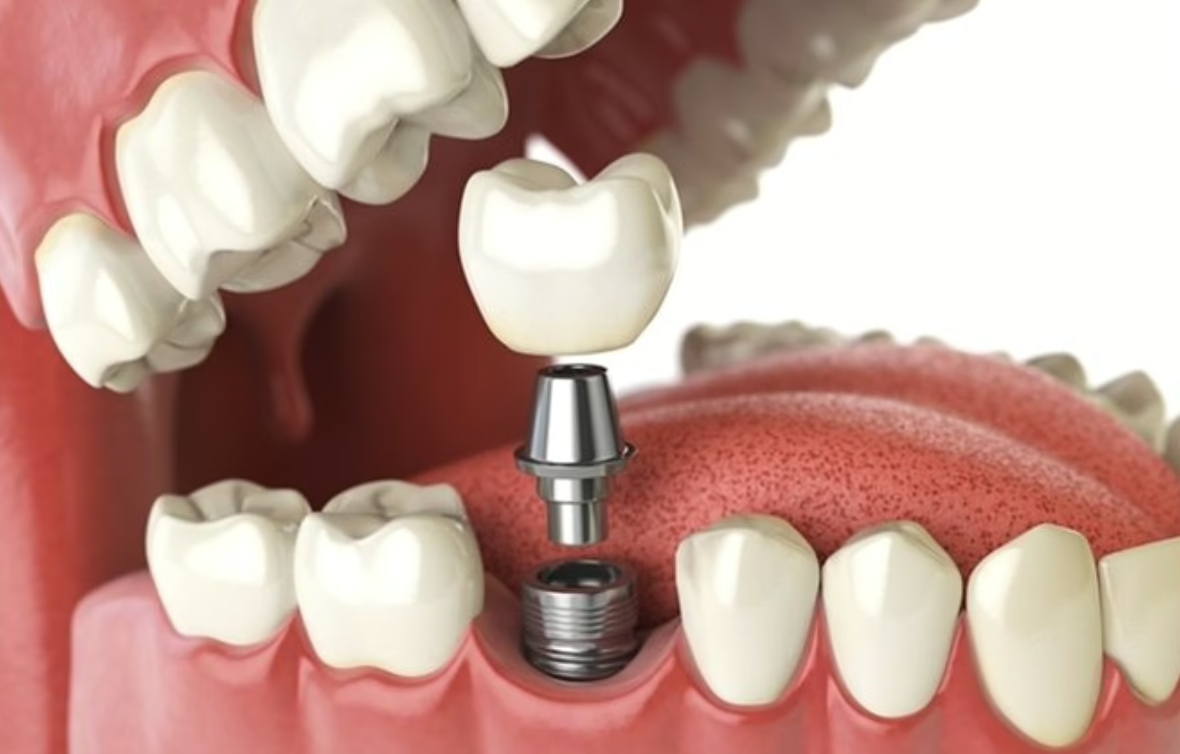
While saving the tooth is the priority, some cases are too severe for a root canal to be viable. In these instances, the alternative is extraction followed by dental implants, a procedure led by Dr Ope Sodeinde to restore full function. If a previous root canal has failed, options include Root Canal Retreatment at £1500 or Root Canal (Peri-radicular) Surgery (apicoectomy) at £2000. These choices depend entirely on your clinical assessment, and while we aim for the best possible outcome, no dental procedure carries a total guarantee.
Strip away the horror stories and a root canal is really just five straightforward steps, starting with an X-ray to see exactly what's going on inside the tooth. While a filling is often completed in a single hour, a root canal is a more detailed rescue mission that may require one or two appointments depending on the complexity of the infection.
Your clinician begins with a clinical examination and dental X-rays to map the root anatomy and detect hidden fractures or bone loss. In some cases, 3D Imaging (CBCT Scans) is used to provide a precise map of the canals before treatment begins.
To ensure you are comfortable, a local anaesthetic is used to numb the tooth and surrounding area. You will remain awake, but the numbing agent ensures you do not feel pain during the procedure.
Using a process called orthograde endodontics, the clinician accesses the tooth through the normal root canal opening. Specialised tools are used to remove the infected pulp and diseased tissue, thoroughly cleaning and disinfecting the inner canals.
Once the canals are shaped and cleaned, they are sealed to prevent bacteria from re-entering. The tooth is then restored; for larger repairs, this may involve a White Filling (2 surfaces) priced between £200/visit and £260, using durable, tooth-coloured composite resin.
Because a tooth can be more fragile after a root canal, a crown is often advised to restore its full shape and size. Porcelain Crowns from £2,500/tooth and provide a durable, premium restoration that comes with a 5-year warranty.
It is common to wonder which part of the process is more difficult; however, because the tooth is numbed first, the procedure itself is managed, though some soreness afterwards can vary between patients.
If you are unsure whether your symptoms require a filling or a specialist root canal, a clinical assessment is the first step to determining the right treatment plan.
Patients ask the same handful of questions once they're sat in the chair, so here they are, answered straight.
Root canals are technically demanding because they require working within small, complex anatomy that varies from person to person. Because of this precision, some general dentists prefer to refer these cases to a specialist who has advanced training in endodontics.
Neither should be painful during the procedure due to the use of local anaesthetic. While root canals have a reputation for being difficult, they are designed to remove the source of infection and actually relieve the pain caused by a damaged nerve.
A root canal is usually not an option if the tooth has suffered a vertical fracture or if there is not enough healthy tooth structure left to support a restoration. In these cases, a dentist may advise extraction because the tooth can no longer be safely restored.
With proper care and a high-quality restoration, such as a crown, a root-filled tooth can last for many years or even a lifetime. The longevity depends on the original condition of the tooth and how well the remaining structure is protected from future decay.
A deep filling can sometimes irritate the nerve or leave a small amount of decay behind, which may lead to a slow-developing infection. If the nerve eventually dies or becomes inflamed despite the filling, a root canal is needed to clear the canal and save the tooth.
If that sounds like your tooth, the next sensible step is to have Dr Neha Patel take a proper look before anyone decides what work it actually needs. You may be in a position where a general dentist has suggested a root canal, but you are wondering if a filling would be adequate for the cavity. For example, a patient might have a deep decay on an upper molar that feels sensitive to cold; while it looks like a simple cavity on the surface, only a specialist examination can determine if the infection has already reached the pulp.
Dr Neha Patel, Specialist in Endodontics, provides these detailed assessments at our clinic in Primrose Hill. A Root Canal Consultation is £245. The consultation fee goes towards the cost of any treatment you go on to have with us, so it is not an extra on top. You can find further details on our dental treatment fees in London.
To make the most of your appointment, please bring any previous X-rays or your referral letter. We are open Monday to Friday, 08:30 to 18:00, and you can reach us by phone at +442075897792 to arrange your visit.
Not sure where to start?
Book a Root Canal consultation with London Dental Specialists (£245). Call +442075897792 or visit london-dental-specialists.co.uk. The consultation fee goes towards the cost of any treatment you go on to have with us, so it is not an extra on top.
Dr Ope Sodeinde, Principal Dentist & Clinical Director, GDC registration 104071 (Specialist in Periodontics), BDS (Hons), MFDS RCS(Ed), MSc Restorative Dentistry, MClinDent Periodontics, MPerio RCS(Ed)
Principal Dentist & Clinical Director; founder and owner of the practice.