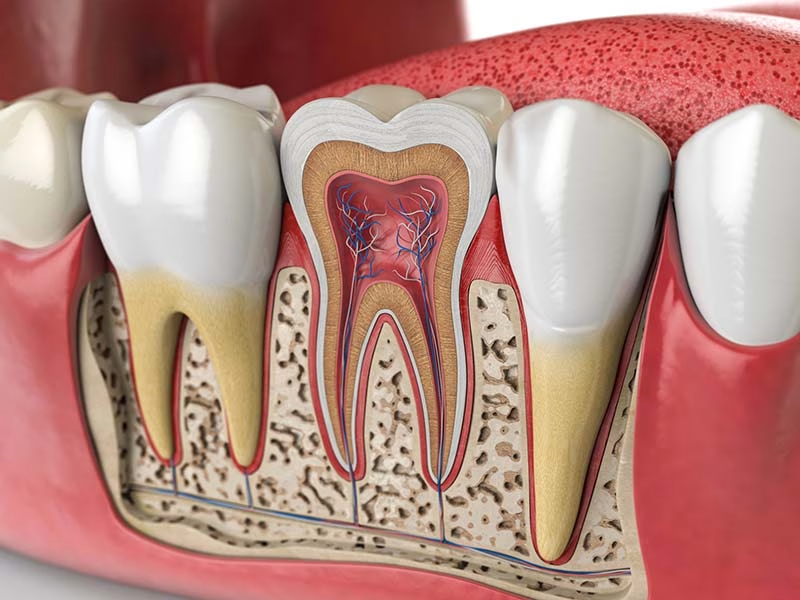
At London Dental Specialists, we understand that procedural errors can occur during complex dental treatments, particularly in endodontic procedures. These complications may include issues with working length, cleaning and shaping errors (such as ledge formation, perforations, or instrument fracture), and problems with obturation quality. Our specialists are highly trained to prevent these errors through meticulous technique and advanced technology. However, should complications arise, we offer comprehensive solutions including retreatment, apicoectomy, or extraction with implant placement when necessary. We prioritise transparent communication about potential challenges and their management, ensuring patients feel informed and confident throughout their treatment journey.
What are common procedural errors in endodontic treatment?
Common procedural errors in endodontic treatment include:
- Length errors (overfill and underfill)
- Cleaning and shaping errors (ledge formation, apical transportation, perforations)
- Instrument fracture (separated instruments)
- Obturation quality issues (voids, lack of uniform taper, poor homogeneity)
- Access cavity preparation errors
- Canal identification errors
At London Dental Specialists, our endodontists use advanced techniques and magnification to minimise these complications during root canal treatments.
How does London Dental Specialists manage instrument fracture during root canal treatment?
London Dental Specialists manages instrument fracture through a systematic approach:
- Immediate assessment using dental microscopes to visualise the fragment
- Evaluation of the fragment's position and potential impact on treatment outcome
- Attempt to retrieve the fragment using specialised ultrasonic instruments and microforceps
- If retrieval isn't possible, bypassing the fragment while maintaining canal integrity
- In complex cases, considering surgical approaches like apicoectomy
Our specialists have extensive experience managing these complications with high success rates, ensuring optimal outcomes even in challenging situations.
What solutions are available for failed root canal treatments?
For failed root canal treatments, London Dental Specialists offers several evidence-based solutions:
- Endodontic retreatment - removing previous filling materials and addressing missed canals or infections
- Apicoectomy (root-end surgery) - surgical approach to treat persistent infections at the root tip
- Extraction and dental implant placement - when the tooth cannot be saved
- Guided tissue regeneration - for cases with significant bone loss
Our specialists carefully assess each case to recommend the most appropriate treatment with the highest probability of success.
How does London Dental Specialists correct ledge formation during root canal treatment?
London Dental Specialists corrects ledge formation through these specialised techniques:
- Precise identification using dental microscopes and CBCT imaging
- Creating a glide path with pre-curved hand files (typically K-files)
- Utilising flexible nickel-titanium instruments to negotiate past the ledge
- Employing chelating agents to soften dentine and facilitate navigation
- Implementing controlled recapitulation techniques to maintain patency
Our endodontists have extensive training in managing these complex cases, significantly improving outcomes in teeth previously considered untreatable.
What techniques does London Dental Specialists use to manage root perforations?
London Dental Specialists manages root perforations using these advanced techniques:
- Immediate assessment and classification of the perforation (size, location, time since occurrence)
- Isolation with rubber dam to prevent bacterial contamination
- Application of biocompatible repair materials such as MTA (Mineral Trioxide Aggregate) or Biodentine
- Microscope-guided precision placement of repair materials
- In lateral perforations, possible use of guided tissue regeneration techniques
- Follow-up monitoring to ensure healing and resolution
Early intervention by our specialists significantly improves the prognosis for teeth with perforation complications.
How successful is endodontic retreatment at London Dental Specialists?
Endodontic retreatment at London Dental Specialists has a success rate of approximately 80-90% for most cases. Success factors include:
- Comprehensive diagnosis using CBCT imaging to identify all contributing factors
- Complete removal of previous root filling materials
- Identification and treatment of missed canals (present in up to 30% of failed cases)
- Thorough disinfection protocols to eliminate persistent infections
- Advanced obturation techniques ensuring complete sealing
Our specialists provide detailed assessments of individual case prognosis during consultation, ensuring patients can make informed decisions about their treatment options.
What preventive measures does London Dental Specialists take to avoid procedural errors?
London Dental Specialists implements these preventive measures to avoid procedural errors:
- Pre-operative CBCT imaging to understand root anatomy and identify potential challenges
- Use of dental operating microscopes for enhanced visualisation throughout procedures
- Implementation of controlled, conservative access designs to preserve tooth structure
- Electronic apex locators combined with radiographic verification for accurate working length
- Single-use instruments to ensure optimal cutting efficiency and reduce fracture risk
- Continuous irrigation protocols to maintain canal patency and prevent blockages
- Regular case planning meetings for complex treatments
These proactive approaches significantly reduce the incidence of complications during endodontic procedures.
How does London Dental Specialists manage cases with calcified canals?
London Dental Specialists manages calcified canals through this systematic approach:
- Pre-operative CBCT imaging to map the expected canal path and identify calcification extent
- Guided endodontic access using 3D-printed guides in severely calcified cases
- Utilisation of dental operating microscopes with enhanced illumination
- Application of specific dyes to highlight the canal entrance
- Use of ultrasonic instruments for controlled dentine removal
- Small hand files (size 06, 08, 10) with EDTA lubricants to negotiate narrow pathways
Our specialists have extensive experience in treating calcified canals that might otherwise be deemed untreatable, preserving natural teeth and avoiding extraction.
Can’t find the answer to your Management of Procedural Errors in Complex Cases questions here? Always feel welcome to
contact us with your Management of Procedural Errors in Complex Cases questions and concerns.