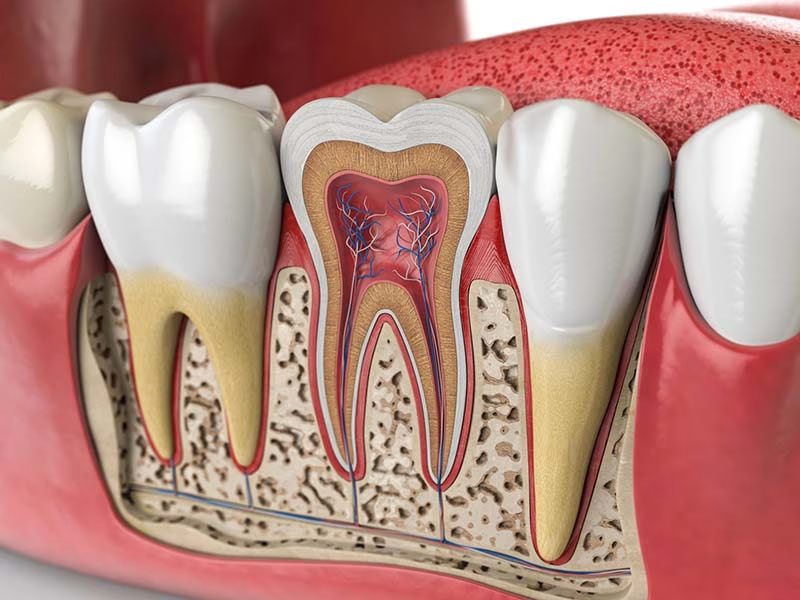
At London Dental Specialists, we understand that dental procedures like pulpotomy can raise questions. This partial pulp removal treatment preserves tooth vitality by removing only the infected coronal portion of the pulp while leaving the healthy radicular pulp intact. Different techniques exist, including Cvek pulpotomy which removes just 2mm of pulp below the exposure point. The procedure offers significant advantages for damaged young permanent teeth, providing high clinical success rates while postponing more invasive endodontic treatments. Our specialists use precise instruments like spoon excavators and appropriate burs to ensure effective treatment with minimal discomfort. Here are answers to common questions about this tooth-saving procedure.
What is a pulpotomy and when is it needed?
A pulpotomy is a dental procedure that involves the removal of the upper portion of the dental pulp (the crown), whilst preserving the vitality of the remaining pulp tissue. At London Dental Specialists, we recommend this procedure when tooth decay or trauma has affected the pulp but hasn't spread to the root canals. It's particularly beneficial for children with damaged primary teeth or young adults with permanent teeth that haven't fully developed their roots.
What portion of the pulp is removed in a pulpotomy?
In a pulpotomy, only the upper portion of the pulp (the crown) is removed. This differs from a pulpectomy, which involves the complete removal of pulp from the entire tooth. At London Dental Specialists, our dentists carefully remove just the infected or inflamed coronal pulp tissue whilst preserving the healthy pulp in the root canals, allowing the tooth to maintain its vitality and continue developing normally.
How is the pulp removed during a pulpotomy procedure?
During a pulpotomy at London Dental Specialists, our dentists carefully remove the affected pulp using specialised techniques:
- We use a high-speed bur to access the pulp chamber, staying well away from the chamber floor to avoid perforation
- A spoon excavator is used to gently remove the remaining pulp in the chamber
- In some cases, we may use a large slow-speed bur under irrigation to ensure complete removal of the coronal pulp
- After removal, a medicament is placed over the remaining pulp tissue to promote healing and prevent infection
What is the difference between a partial pulpotomy and a Cvek pulpotomy?
A partial pulpotomy and a Cvek pulpotomy refer to the same procedure. In this technique, only about 2mm of the pulp below the exposure point is removed, leaving a wound of healthy pulp where a medicament dressing is placed. At London Dental Specialists, we perform Cvek pulpotomies to preserve as much healthy pulp tissue as possible, particularly in young permanent teeth where continued root development is essential.
What are the advantages of a partial pulpotomy?
Partial pulpotomy offers several significant advantages:
- High clinical and radiographic success rates
- Preservation of tooth vitality and natural function
- Allows for continued root development in young permanent teeth
- Less invasive than complete root canal treatment
- Postpones more invasive endodontic treatments
- Provides biological benefits by maintaining pulp vitality
At London Dental Specialists, we recommend this procedure for highly damaged young permanent teeth whenever possible.
Is a pulpotomy painful?
At London Dental Specialists, we ensure patient comfort during pulpotomy procedures. The treatment is performed under local anaesthesia, so patients should feel no pain during the procedure. Some mild discomfort might be experienced after the anaesthesia wears off, but this typically subsides within a day or two. We provide appropriate pain management advice and medication recommendations if needed.
How long does a pulpotomy last?
With proper care and regular check-ups at London Dental Specialists, a pulpotomy can be highly successful. In primary teeth, a pulpotomy can maintain the tooth until its natural exfoliation. In permanent teeth, the success rate is also high, with many treatments lasting indefinitely when followed by appropriate restoration. We recommend biannual check-ups to monitor the treated tooth and ensure long-term success.
What happens after a pulpotomy procedure?
After a pulpotomy at London Dental Specialists, the tooth typically requires a final restoration:
- For primary teeth, a stainless steel crown is often placed to protect the tooth
- For permanent teeth, a composite restoration or crown may be recommended
- We provide detailed aftercare instructions to ensure proper healing
- A follow-up appointment will be scheduled to assess the healing process
- Regular check-ups are essential to monitor the long-term success of the treatment
Who is a good candidate for a pulpotomy?
Ideal candidates for pulpotomy at London Dental Specialists include:
- Children with damaged primary teeth that need to be preserved until natural exfoliation
- Young patients with permanent teeth that have exposed pulp due to trauma or decay
- Patients with teeth that show signs of pulpal inflammation but not extensive infection
- Young permanent teeth with incomplete root formation
Our specialists conduct a thorough examination, including radiographs, to determine if a pulpotomy is the most appropriate treatment for each individual case.
Can’t find the answer to your Pulpotomy for Partial Pulp Removal questions here? Always feel welcome to
contact us with your Pulpotomy for Partial Pulp Removal questions and concerns.